
Casinos That Accept Bank Cheques in the UK
 Available in GB
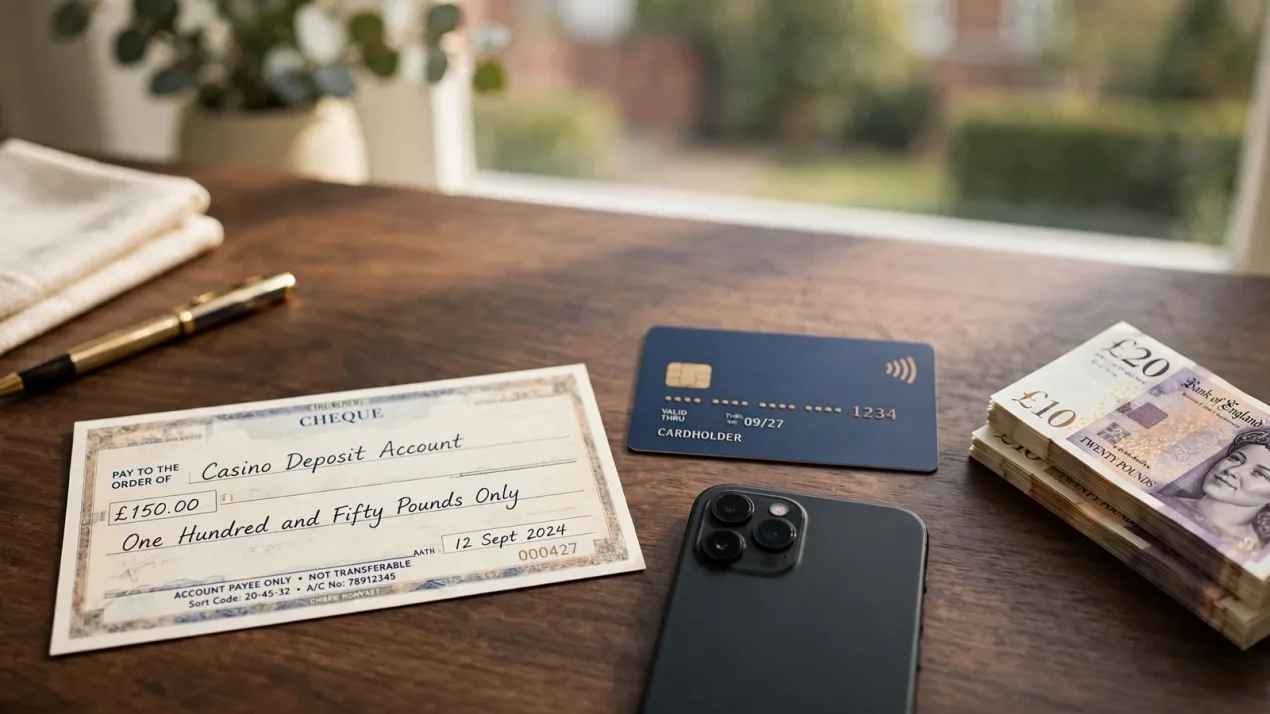
Content
A bank cheque is a banking instrument, while Boku deposits are charged through a mobile account; the two are not interchangeable.
The evidence on cheque payments and UK online casinos
A bank cheque and a Pay by Phone deposit are different payment methods. A cheque is a banking instrument; Pay by Phone refers to a payment charged through a mobile account. Boku belongs to the latter category. Evidence about Boku therefore cannot establish that an online casino accepts bank cheques, even where both methods appear in discussions of ways to fund a gambling account.
That distinction matters when assessing claims about online casino sites accepting cheques: a reference to a mobile-billed payment, or to a service that uses a phone number, is not evidence of cheque acceptance. Nor does a list of casinos that accept Pay by Phone answer whether a bank cheque can be used. The payment method itself needs to be established, rather than inferred from a broad label such as “alternative payments”.
The same care applies to requests for the best or top casino sites accepting cheques in the UK. A ranking would imply that the listed operators have been verified as accepting this specific deposit method. Without that confirmation, naming or ranking operators would turn an uncertain claim into a recommendation. No operator should be treated as a cheque option merely because it accepts Boku.
When looking for a UK casino that accepts bank cheques, check that the payment method is explicitly supported before signing up. The available information here gives payout speeds but does not confirm bank-cheque acceptance.
1. Zombillion
Payout speed: 1-3 business days
The listed payout speed is 1–3 business days. Bank-cheque acceptance is not confirmed by the available information.
2. SlotoSport
Payout speed: 1-3 business days
The listed payout speed is 1–3 business days. Bank-cheque acceptance is not confirmed by the available information.
3. Jetsetspins
Payout speed: 1-3 business days
The listed payout speed is 1–3 business days. Bank-cheque acceptance is not confirmed by the available information.
4. NightWin
Payout speed: 1-3 business days
The listed payout speed is 1–3 business days. Bank-cheque acceptance is not confirmed by the available information.
5. EvoSpin
Payout speed: 1-3 business days
The listed payout speed is 1–3 business days. Bank-cheque acceptance is not confirmed by the available information.
6. WinBeast
Payout speed: 1-3 business days
The listed payout speed is 1–3 business days. Bank-cheque acceptance is not confirmed by the available information.
7. Chanze
Payout speed: 1-3 business days
The listed payout speed is 1–3 business days. Bank-cheque acceptance is not confirmed by the available information.
8. Britsino
Payout speed: 1-3 business days
The listed payout speed is 1–3 business days. Bank-cheque acceptance is not confirmed by the available information.
9. Dieselwin
Payout speed: 1-3 business days
The listed payout speed is 1–3 business days. Bank-cheque acceptance is not confirmed by the available information.
10. SpinFormula
Payout speed: 1-3 business days
The listed payout speed is 1–3 business days. Bank-cheque acceptance is not confirmed by the available information.
The term “cheque deposit” can also be used loosely in online discussions, potentially obscuring the distinction between depositing money from a bank account and using a cheque as the instrument. For a bank-cheque claim to be meaningful, the casino’s own payment information would need to identify cheques as an accepted way to deposit, with the relevant conditions made clear. A reference to a different payment service is not enough. This is particularly important when payment arrangements change, since a casino’s current cashier may not match an older description.
Payment acceptance is only one part of assessing an online casino in Great Britain. Commercial gambling is regulated by the UK Gambling Commission, which oversees remote gambling offered to consumers in Great Britain even when the operator’s key equipment is located elsewhere. It is the sole regulator for commercial gambling in Great Britain. The Commission grants operating licences to businesses and personal licences to individuals who work in relevant roles. These responsibilities make licensing a separate question from whether a particular deposit method is available.
A licence does not prove that a casino accepts cheques. It establishes the operator’s regulatory status, not the presence of a specific option in its cashier. Conversely, a payment-method claim does not establish that the operator is authorised to serve customers in Great Britain. The two checks should not be collapsed into one: payment evidence concerns the route by which funds may be deposited, while licensing concerns whether the business is permitted to provide the gambling service in the relevant market.
Echeck Casinos in the UK: How to Verify Availability
For a UK-facing online casino, the relevant licensing position should be checked independently before money is deposited. The UK Gambling Commission’s public register is the place to verify an operator’s licence status. The casino name and the business named on the register should correspond; a payment method displayed on a site cannot substitute for that check. This is a basic distinction between verifying the supplier and verifying a particular financial feature.
The phrase “casinos that accept bank cheque UK 2026” therefore needs a narrow interpretation. It asks for casinos whose current payment arrangements specifically support bank cheques, not casinos that accept Pay by Phone, Boku, or another method that may be described broadly as a deposit option. The year in the phrase does not itself confirm that any operator has added cheque deposits. A claim remains dependent on current operator information and should not be inferred from the existence of other payment methods.
The defensible distinction is straightforward: Boku is evidence about Pay by Phone, not evidence of bank-cheque acceptance. Licensing is a separate matter governed in Great Britain by the UK Gambling Commission, whose register can be used to check an operator’s status.
Do
- Verify the operator’s licence on the UK Gambling Commission’s public register
- Check the casino’s current cashier for specific payment methods
- Match the casino name with the business name on the official register
Don’t
- Assume a licence proves a casino accepts bank cheques
- Infer cheque acceptance from the presence of Boku or Pay by Phone
- Use a payment method list as a substitute for a regulatory licence check
What the available evidence says about online casino payment options
The pay-by-phone option with a continuing, though limited, presence at UK-licensed online casinos is Boku. The number of operators reported to accept it has fallen since 2023. This is a change in the availability of one payment method, not evidence that every casino has the same cashier options or that Boku remains available at any particular site.
A specialist review describes operators moving away from Boku after 2023, with some adopting other pay-by-phone services and others removing mobile-payment options. That account should be read as a report of a changing market rather than a permanent inventory. Payment arrangements are operator-specific and can change, so an older description of a casino’s cashier does not establish what it accepts now. The broad direction reported is a contraction in direct Boku acceptance, while the precise current set of casinos cannot be inferred from that trend alone.
This distinction matters because payment labels can make different arrangements appear interchangeable. Boku is a named payment service; a casino’s acceptance of another pay-by-phone method does not amount to acceptance of Boku. Nor does the presence of a payment method at one operator establish that it is offered throughout the UK market.
The relevant regulatory boundary is separate from payment availability. The UK Gambling Commission regulates commercial gambling in Great Britain, including remote gambling offered to consumers there. An operator’s location does not remove the licensing requirement when it provides remote gambling to people in Great Britain. The Commission grants operating licences to gambling businesses and personal licences to individuals in relevant roles. Northern Ireland is outside the scope of the Gambling Act 2005, which governs gambling in England, Wales and Scotland.
Casinos That Accept Neosurf in the UK: What to Check
Accordingly, payment information should be considered only after the operator’s UK status is established. A casino appearing in a payment-method listing is not, by that fact alone, shown to hold the required licence. Online gambling is legal in the UK only through licensed and regulated sites, and every legal online casino serving UK players must hold a current operating licence. Checking the UK Gambling Commission’s public register is therefore a distinct step from checking whether a cashier lists Boku. Neither check substitutes for the other.
The word “accept” also needs a precise object. A casino can accept deposits through a payment service without accepting every other method associated with the same broad category. Conversely, the disappearance of Boku from an operator’s cashier would not establish that the casino has stopped accepting all pay-by-phone payments. Reports of operators switching services or withdrawing mobile-payment options describe different outcomes; they should not be compressed into a single claim that the whole category has either remained or vanished.
An operator’s current cashier and licence status are separate matters to verify at the point of use.
For casino payment comparisons, this makes the method’s exact name and the date of the information important. A general reference to mobile payments may cover services other than Boku, while a reference to Boku may no longer reflect the live cashier. The defensible distinction is between a small surviving Boku presence and the wider, changing category of pay-by-phone payments.
Northern Ireland is outside the scope of the Gambling Act 2005, which governs gambling in England, Wales and Scotland.
Why 2026 cheque searches need careful interpretation
A request for a UK casino that accepts bank cheques is specifically about paying by cheque. That is not the same as asking whether a casino accepts Pay by Phone. The two methods involve different payment arrangements, so evidence about one cannot establish that the other is available. The distinction matters when assessing claims about casinos accepting cheques in 2026: a reference to a mobile-billed deposit does not answer whether a bank cheque can be used.
Boku is relevant to some discussions of casino payments, but it does not provide evidence of cheque acceptance. Its presence in a casino payment list, where applicable, concerns a separate method. A page or comparison that treats any non-card payment as interchangeable with a cheque risks giving an inaccurate impression of what a cashier supports. For a claim about cheques to be meaningful, it would need to identify cheque payment specifically, rather than rely on a general reference to deposits or alternative payment options.
The date in the wording also calls for care. A casino’s cashier options can change, and information about a payment method at one point does not necessarily describe its availability in 2026. A past reference to Boku, for instance, cannot show that it remains available now, let alone that the casino accepts bank cheques. The relevant distinction is not simply whether an operator has supported a payment option, but which option was supported and when.
Casinos That Accept MuchBetter in the UK
The UK Gambling Commission did not introduce a rule naming Boku and prohibiting its use. Rather, individual casino operators stopped offering it because of compliance risk. That difference is important: a market change attributed to operator decisions should not be recast as a regulator’s blanket ban. Nor does the reason given for operators’ decisions establish anything about cheque processing. It explains a change concerning Boku, not the availability of bank cheques.
Regulatory status is a separate question from payment method. Remote gambling operators offering services to consumers in Great Britain must hold the relevant Gambling Commission licence, regardless of where their equipment is located. A licence indicates that an operator is within the applicable regulatory framework; it does not confirm that a particular payment option is accepted. Checking a casino’s licence and checking its cashier are therefore distinct steps in evaluating a claim.
This also affects how descriptions such as “best UK casinos that accept bank cheques” should be read. A ranking cannot substantiate the underlying payment claim merely by labelling a casino as a cheque option. The claim needs to be supported by information that actually identifies bank cheques as an accepted deposit method. General references to casino payments, Boku, or other forms of Pay by Phone are not substitutes.
Accordingly, the available information about Boku supports a limited conclusion: operators’ decisions about that method were shaped by compliance concerns, not by a UKGC rule banning it by name. It does not establish that any casino accepts bank cheques. Keeping those points separate avoids turning evidence about one payment method into an unsupported claim about another.
Attention: A ranking or label such as "best UK casinos" does not substantiate a payment claim unless bank cheques are specifically identified as an accepted method.
How Boku deposits work—and why they are not cheque deposits
Boku works through a mobile phone account, not a bank cheque. In a casino cashier that offers Boku, the deposit process begins by selecting the payment method and entering an amount alongside the mobile number associated with the account. The transaction is then confirmed using a verification code sent by SMS. The charge is applied to the player’s phone account rather than being presented to a bank for payment as a cheque would be.
That distinction matters when interpreting references to casino deposits by cheque. A bank cheque is a payment instrument connected to a bank account; Boku uses the mobile network to bill or debit the phone account. Both can be described loosely as ways to pay, but they are not interchangeable methods. A deposit made through Boku is not a cheque deposit simply because the money is ultimately paid for by the customer.
The way the Boku charge is settled depends on the mobile plan. For a pay-monthly customer, the deposit can appear as a charge on the mobile phone bill. For a pay-as-you-go customer, it can be taken from available prepaid credit. In either case, the mobile account is the funding route. The payment flow does not involve writing, sending or depositing a cheque through the casino cashier.
Casinos That Accept UKash in the UK: Current Status
The SMS step is part of the transaction rather than a separate bank payment. After the phone number and deposit amount have been entered, the code is used to confirm the request. This ties the transaction to the mobile number supplied during payment. The exact cashier layout may vary between operators, but the documented sequence is to choose Boku, enter the details and confirm by text message.
A casino cashier may label its available methods by provider or payment type, so the presence of a phone-billing option should not be read as evidence that bank cheques are accepted. Equally, a reference to a cheque payment does not establish that Boku is available. The method has to be identified by its actual transaction mechanism: mobile billing or prepaid phone credit points to Boku; a bank cheque would be a different payment instrument.
This also clarifies why descriptions of a “cheque casino” can be misleading. The phrase may be used imprecisely for a casino payment that does not use a card, but the Boku process remains tied to a mobile account. It does not turn a phone-billed transaction into a bank-cheque deposit, nor does the cashier procedure described here establish that any online casino accepts cheques.
For anyone comparing payment labels, the meaningful detail is how the money moves. With Boku, the casino cashier initiates a request through the mobile number, and confirmation arrives by SMS; the resulting charge is assigned to a monthly bill or deducted from PAYG credit. Those steps describe Pay by Phone. They do not describe depositing a cheque at an online casino.
Boku Deposit Process
Step 1: Selection
Select Boku as the payment method in the casino cashier and enter the deposit amount.
Step 2: Identification
Provide the mobile phone number associated with the account to be charged.
Step 3: Verification
Enter the verification code sent via SMS to confirm the transaction.
What happens after a pay-by-phone deposit
Boku can be used to put money into a casino account, but it cannot be selected later to receive a withdrawal. It is a deposit-only method. That distinction matters because the route used to fund an account does not necessarily provide a route for taking funds back out.
A player who deposits through Boku therefore needs a separate withdrawal method. Common categories include a debit card, an e-wallet or a bank transfer, but the methods available depend on the casino and the account. The withdrawal option should be established before depositing: a payment method appearing in the cashier for deposits does not show that it can also receive withdrawals.
This limitation is relevant to searches for casinos accepting bank cheques or other cheque payments. Boku is not a cheque service and does not provide a cheque withdrawal route. Its role is limited to funding the casino balance. Whether a particular operator accepts cheques for deposits or withdrawals is a separate question and cannot be inferred from its support for Boku.
The distinction also affects how winnings are accessed. A balance held in a casino account is not the same as money returned to a bank account or other payment service. If Boku was used to deposit, a withdrawal must be requested through an alternative method that the operator makes available and permits for the account. The applicable process and conditions are set by that operator; Boku itself cannot complete the payout.
Casinos That Accept Ethereum in the UK
Before making a deposit, the casino’s cashier and withdrawal rules should be checked together. This helps establish whether an available payout route is suitable and whether any account requirements apply. The operator must also hold a valid UK Gambling Commission licence to offer online gambling legally in Great Britain. Its licence can be checked on the Commission’s public register before money is deposited.
A search for online casinos accepting cheque payments should not be treated as evidence that a Boku-supported casino accepts cheques. The two payment arrangements have different functions, and Boku’s deposit-only status leaves the withdrawal decision to another supported method. For any casino account, the relevant point is not simply whether a deposit can be made, but whether an authorised withdrawal route is available for returning funds.
Boku deposit limits and payment conditions
Published descriptions of Boku limits do not agree on a single per-transaction ceiling. One specialist review gives £30 as the standard UK transaction limit and says some casinos or mobile network operators may permit £40 or £50. Other specialist accounts describe a lower per-transaction figure of about £10 alongside a £30 daily network limit; another version gives a £30 daily limit but specifies no separate transaction cap. These figures should therefore be treated as reported conditions, not as a uniform limit applying to every account or operator.
Reported Boku Limits
- Standard UK transaction limit: £30 (some casinos/networks may permit £40 or £50).
- Alternative reporting: £10 per transaction with a £30 daily network limit.
- Pay As You Go (PAYG) limit: Cannot exceed the remaining prepaid credit on the phone.
The difference matters because a casino cashier may not be the only point at which a deposit is checked. A casino can set conditions for the amounts it accepts, while the mobile network may impose its own restrictions. A specialist review attributes enforcement of the daily Boku cap to the mobile operator rather than the casino. That account indicates that a deposit can be declined even when the amount appears acceptable in the casino’s cashier, if the network’s limit has been reached. The available descriptions do not establish that every network applies an identical cap.
The network-level figures also should not be confused with the amount available for a particular transaction. A stated daily ceiling describes the total that may be processed over a day, whereas a transaction limit concerns an individual payment. Where a source reports both, the two restrictions can operate together. Where it reports only a daily ceiling, that does not establish a per-payment maximum. The distinction is important given the conflicting descriptions of Boku’s limits.
Payment conditions can differ further for prepaid mobile accounts. A specialist review states that a PAYG Boku deposit cannot exceed the credit remaining on the phone. Under that condition, a deposit request might fall within a stated transaction ceiling and still fail because the prepaid balance is insufficient. This is a funding constraint, separate from any casino or network limit, and the report should not be read as proof that every PAYG arrangement has identical terms.
The practical limit is therefore not safely inferred from a single headline amount. Reported UK figures include a £30 transaction ceiling, possible higher limits at some casinos or networks, and accounts of a £10 transaction figure paired with a £30 daily cap. The disagreement is explicit, and conditions may depend on the casino, network and account type. A cashier’s currently displayed terms and any message from the mobile operator are more relevant to an individual payment than a general figure presented without that qualification.
Which payment method the term “cheque casino” may obscure
A payment described informally as a casino “cheque” option can be confused with a different kind of transaction: Boku, which uses a mobile phone account as the source of funds. It is not a bank cheque and does not draw on a cheque account. The distinction matters because the payment route determines where the deposit is charged.
With Boku, a postpaid customer’s deposit is added to the mobile phone bill. A Pay As You Go customer’s deposit is instead taken from prepaid phone credit. In neither case is the transaction processed by writing, depositing or cashing a bank cheque. The shared feature is only that the payment is associated with a customer’s phone service; that does not make it a cheque payment.
The difference is especially relevant to prepaid accounts. A specialist payment-method review describes Boku deposits for Pay As You Go users as limited by the credit remaining on the phone: a deposit cannot exceed that available balance. If the balance is insufficient, it cannot cover the requested deposit. This condition concerns the source of the money, rather than a cheque being presented to a casino or bank.
Postpaid Customers
The deposit is added to the user’s monthly mobile phone bill.
Pay As You Go Customers
The deposit is deducted from the available prepaid phone credit.
Funding Constraint
Deposits are limited by the mobile account balance and network-imposed caps.
The label “bank cheque casino” therefore should not be taken as evidence that an online casino accepts cheques. Boku offers a way to charge a deposit to a phone bill or deduct it from prepaid credit. Those arrangements do not establish that the casino accepts a bank-issued cheque, nor that a cheque can be used to fund a gambling account. The two payment types have different mechanisms and should not be treated as interchangeable.
This distinction also affects how a payment method is assessed. For a bill-funded transaction, the mobile account is charged; for a prepaid transaction, the remaining phone balance is the relevant source. Neither description implies a bank transfer or a cheque clearing process. A casino cashier’s reference to Boku, where available, would indicate a Pay by Phone route, not cheque acceptance.
Consequently, the phrase “cheque casino” may obscure a search for phone-billed deposits, but that interpretation should not be assumed in every case. A bank cheque and a mobile-account charge are materially different forms of payment. The available information about Boku supports the latter description only. It does not identify an online casino as a verified destination for bank-cheque deposits.
Pay-by-mobile alternatives and their limits as evidence
Boku is not the only name associated with Pay by Phone deposits. Fonix and Siru Mobile are also used for mobile payments, but they are separate services rather than alternative forms of bank cheque. A casino cashier listing one of these methods indicates a phone-based payment route; it does not establish that the casino accepts cheques.
A specialist review describes operators as moving away from Boku since 2023, with Fonix and Siru Mobile among the replacements and some operators removing Pay by Phone altogether. That account concerns changes in mobile payment options, not a general shift towards cheque deposits. The distinction matters because a payment method can look unfamiliar or be grouped under a broad cashier category without changing how it is funded.
The same specialist review identifies MrQ and Duelz as accepting Fonix, and Mr Vegas and Videoslots as accepting Siru Mobile. These operator and provider pairings describe particular mobile-payment arrangements; they should not be read as evidence of bank-cheque acceptance. Payment menus can also change, so a method reported for an operator should not be assumed to remain available without checking its current cashier.
Network support provides another separate part of the picture. Pay by mobile and Fonix are supported by EE, O2, Vodafone and Three. This identifies mobile networks associated with those services, rather than showing that every casino using a service accepts deposits from every network. The payment option displayed by an operator and the networks able to process it are related but distinct details.
For someone comparing casino payment methods, the relevant distinction is between a transaction billed through a mobile network and a cheque handled through a bank. Boku, Fonix and Siru Mobile belong to the first category. Their appearance in an operator’s payment options says nothing by itself about whether paper or bank cheques can be used. A casino described as accepting mobile payments therefore cannot, on that description alone, be treated as a casino accepting cheque deposits.
Mobile Payment Evidence
- Boku, Fonix, and Siru Mobile are pay-by-phone services, not bank cheque methods.
- The presence of these services does not prove that a casino accepts bank cheques.
- Mobile payment availability varies by operator and can change over time.
- Network support (EE, O2, Vodafone, Three) is independent of specific casino acceptance.
The available operator examples illustrate how Pay by Phone options may be branded and replaced, but they do not define a uniform set of payment choices across UK casinos. Each operator controls the methods shown in its own cashier, and a provider’s presence in the market is not proof of acceptance at a particular site. Keeping those distinctions clear prevents mobile-payment information from being mistaken for evidence about bank-cheque transactions.
Bonus terms for mobile-billed casino deposits
Bonus eligibility is determined by each casino’s terms, not by the payment method alone. Pay by Phone deposits may be excluded from welcome offers, so a deposit that reaches an account does not necessarily qualify for a promotion. The bonus rules should be checked before a payment is made, including any conditions that specify which deposit methods count.
A specialist review reports that MrQ, Duelz, Mr Vegas and Videoslots accept Pay by Phone deposits for bonus eligibility. This is a limited, time-sensitive indication rather than a guarantee that every offer at those operators will qualify. Eligibility can differ between promotions and may change when terms are updated. The offer-specific rules therefore remain decisive.
The same specialist review found no Boku-specific deposit restrictions on the platforms it assessed, while noting that Boku deposits generally did not carry dedicated bonuses. That does not establish a universal policy across casinos. It indicates that payment acceptance and bonus qualification are separate questions: an operator may permit a deposit without attaching a promotion to it, or may exclude that payment route from a particular offer.
For an offer advertised as a deposit match or another welcome incentive, the relevant terms should be read for the eligible payment methods, qualifying deposit conditions and any restrictions on bonus funds. General statements about a casino’s promotions cannot establish that a particular Pay by Phone transaction qualifies. The terms in force for the selected offer are the appropriate basis for that assessment.
This distinction also matters when a casino cashier lists a mobile-billed option alongside other methods. Its presence confirms only that the method can be selected for a deposit; it does not, by itself, confirm promotional eligibility. Bonus rules should be checked separately before depositing, particularly because mobile-billed payments may be excluded from welcome offers.
Using Boku indirectly through an e-wallet
A specialist casino-payment review describes an indirect route in which Boku is used to fund a Neteller account, and Neteller is then selected in the cashier of a casino that accepts it. This is not a bank-cheque deposit: the funding path runs through a mobile-billed payment service and an e-wallet, rather than through a cheque paid into a bank account.
The distinction matters because acceptance at each stage is separate. A casino may support Neteller without accepting Boku directly, and the described route depends on Neteller being available at the chosen casino. The review’s account of the route should not be treated as evidence that every Boku user can fund Neteller this way or that every Neteller casino will accept the resulting funds. Payment availability can depend on the services and account conditions involved.
This indirect option also does not change Boku’s role as a deposit method. It does not turn Boku into a cheque service or establish a direct Boku cashier option at a casino. The casino’s own cashier and payment terms remain the relevant place to confirm which deposit methods it accepts.
In Great Britain, an online casino offering real-money gambling must hold the relevant UK Gambling Commission licence. The licence should be checked on the Commission’s public register before depositing. Thus, the Neteller route is best understood as a reported payment path, not as a substitute for confirming either the casino’s licensing status or its current payment arrangements.
What are the deposit limits at pay-by-mobile casinos?
Boku deposits are usually capped at £30 per transaction, although some casinos or mobile networks may allow £40 or £50. Network limits can be lower—typically about £10 per transaction and £30 per day—and PAYG deposits cannot exceed your remaining phone credit.
Are Boku casinos still available in the UK in 2026?
Yes, a small number of UK-licensed casinos still accept Boku, but operators have been dropping it since 2023. Check the casino’s current cashier, as availability varies by operator.
Are Boku deposits eligible for casino bonuses?
Boku deposits generally do not come with specific bonuses, and bonus eligibility varies by casino. Check the operator’s bonus terms before depositing.
How does Boku work?
Choose Boku in the casino cashier, enter an eligible deposit amount and your phone number, then confirm the payment with the SMS verification code. The charge is added to your mobile bill or deducted from your PAYG credit.
How can I be sure Boku is available where I live?
Check whether Boku appears in the casino’s cashier and whether your mobile operator supports pay-by-mobile; the supported UK networks listed include EE, O2, Vodafone and Three.
Related posts

UK Crypto Casinos: No-KYC Claims Explained

TRON TRX Casino Comparison for UK Players
